Towards Considerate Embodied AI
by MakerLAB · Weill Cornell, Coler NY H+H · 2026-09-28
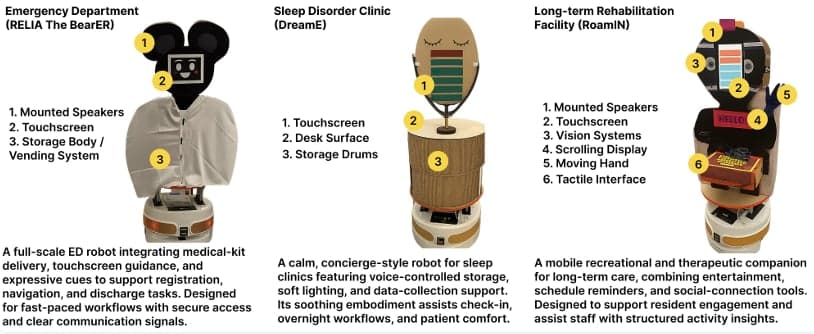
Co-Designing Embodied AI in Healthcare asked clinicians and multidisciplinary teams to design the robots they would actually want on the floor. Over a 14-week workshop spanning an emergency department, a long-term rehabilitation facility and a sleep disorder clinic, participants moved from early brainstorming to three high-fidelity robot prototypes.
Each robot is built on a shared mobile base with a custom upper body for its setting. RELIA the BearER (emergency department) pairs mounted speakers and a touchscreen with a storage body for medical-kit delivery. DreamE (sleep clinic) is a calm, concierge-style robot with a touchscreen, a desk surface and voice-controlled storage drums. RoamIN (rehabilitation) adds vision, a scrolling display, a moving hand and a tactile interface for recreation and social connection.
The bodies are probably made the way most MakerLAB prototypes are: flat wooden panels and slatted forms that were likely laser cut, a fabric shell on RELIA, and off-the-shelf screens and speakers mounted to the frame. Going from abstract concepts to physical prototypes is what let participants weigh real trade-offs: size, noise, storage and how a robot should signal what it is doing.
Tip: when co-designing with busy clinicians, bring a physical mock-up to every session. A cardboard or plywood body on a real base answers questions a sketch cannot.
Partner: Weill Cornell, Coler NY H+H